

Revision Surgery
Persistent or recurrent symptoms after spine surgery do not automatically mean another operation is needed.
Your request does not confirm an appointment.
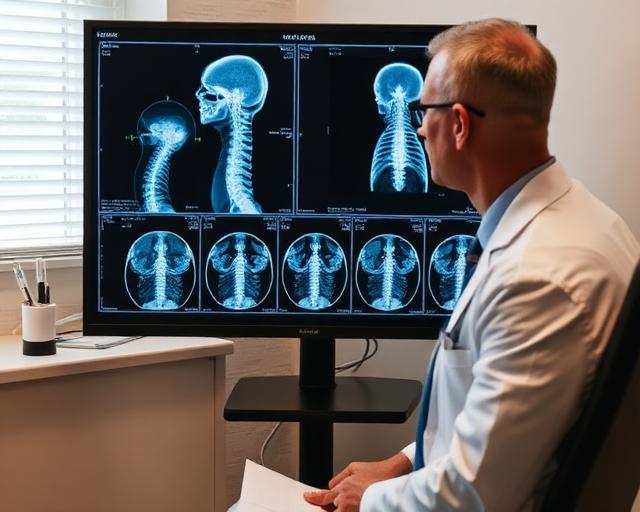
Still in pain after surgery?
Another operation is not automatically the next step. A careful second opinion reviews your symptoms, previous surgery, and imaging to clarify which options deserve consideration.
- Listen
Your history, symptoms, and goals.
- Review
Your imaging and previous treatment.
- Explain
Your options and the next steps.
Information for your evaluation
A second opinion for symptoms after neck or lower-back surgery.
Persistent or recurrent symptoms after spine surgery do not automatically mean another operation is needed. Apteum Spine reviews your prior surgery, symptom timeline, examination findings, and current imaging to help determine what may be causing neck, arm, low-back, sciatica, leg, or walking symptoms and what the most responsible next step may be.
When Symptoms Continue After Spine Surgery
Ongoing symptoms after a prior cervical or lumbar operation can be frustrating and confusing. Some patients have neck pain, arm pain, numbness, weakness, or symptoms after ACDF, cervical fusion, disc replacement, or decompression. Others have persistent low-back pain, sciatica, leg numbness, weakness, or walking limitation after lumbar discectomy, laminectomy, decompression, or fusion.
Possible causes may include symptomatic nonunion, also called pseudoarthrosis, recurrent or residual nerve compression, adjacent-level disease, hardware-related concerns, instability, alignment problems, scar tissue, or pain sources outside the spine. No single imaging finding automatically means another surgery is required. The finding must match the symptoms, examination, and overall clinical picture.
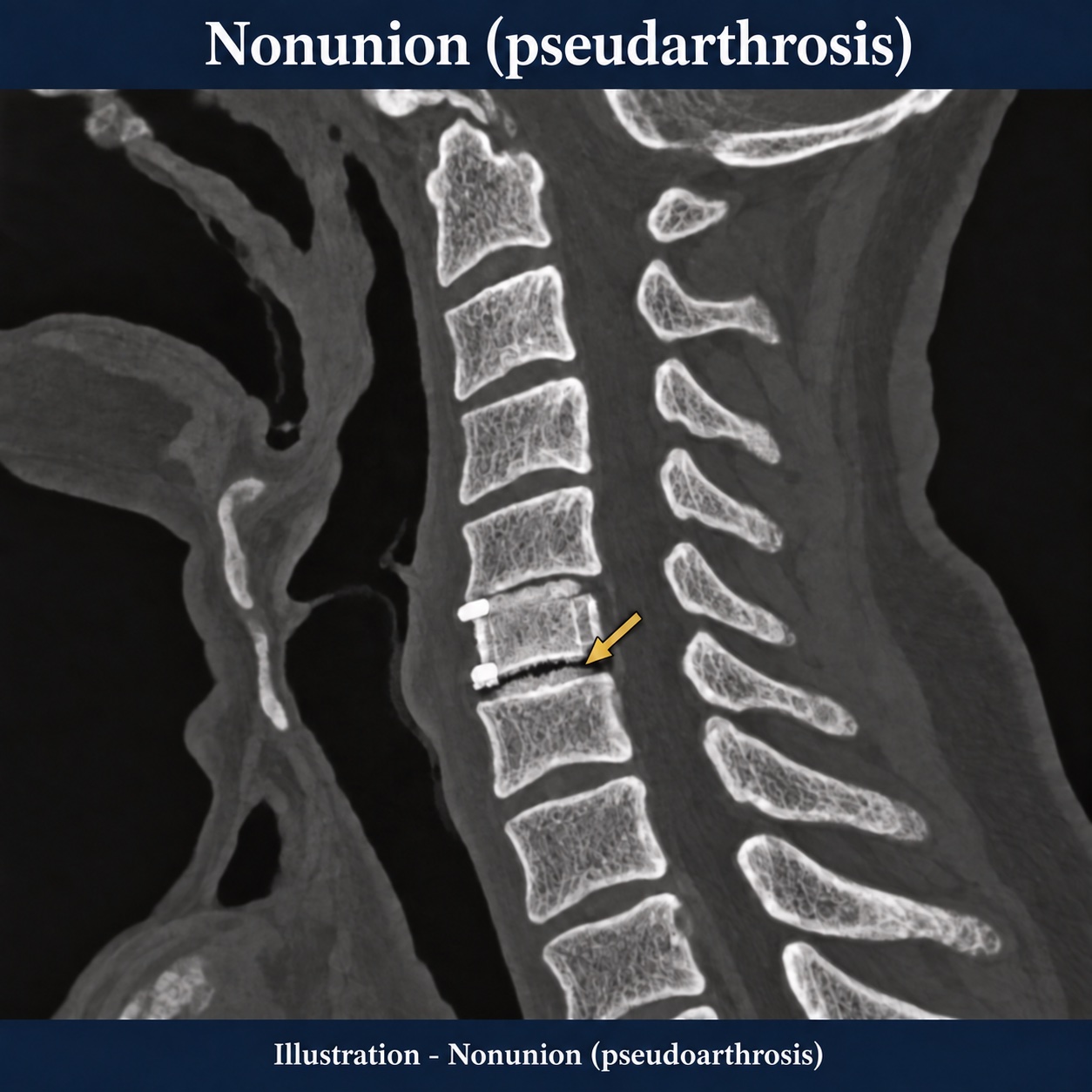
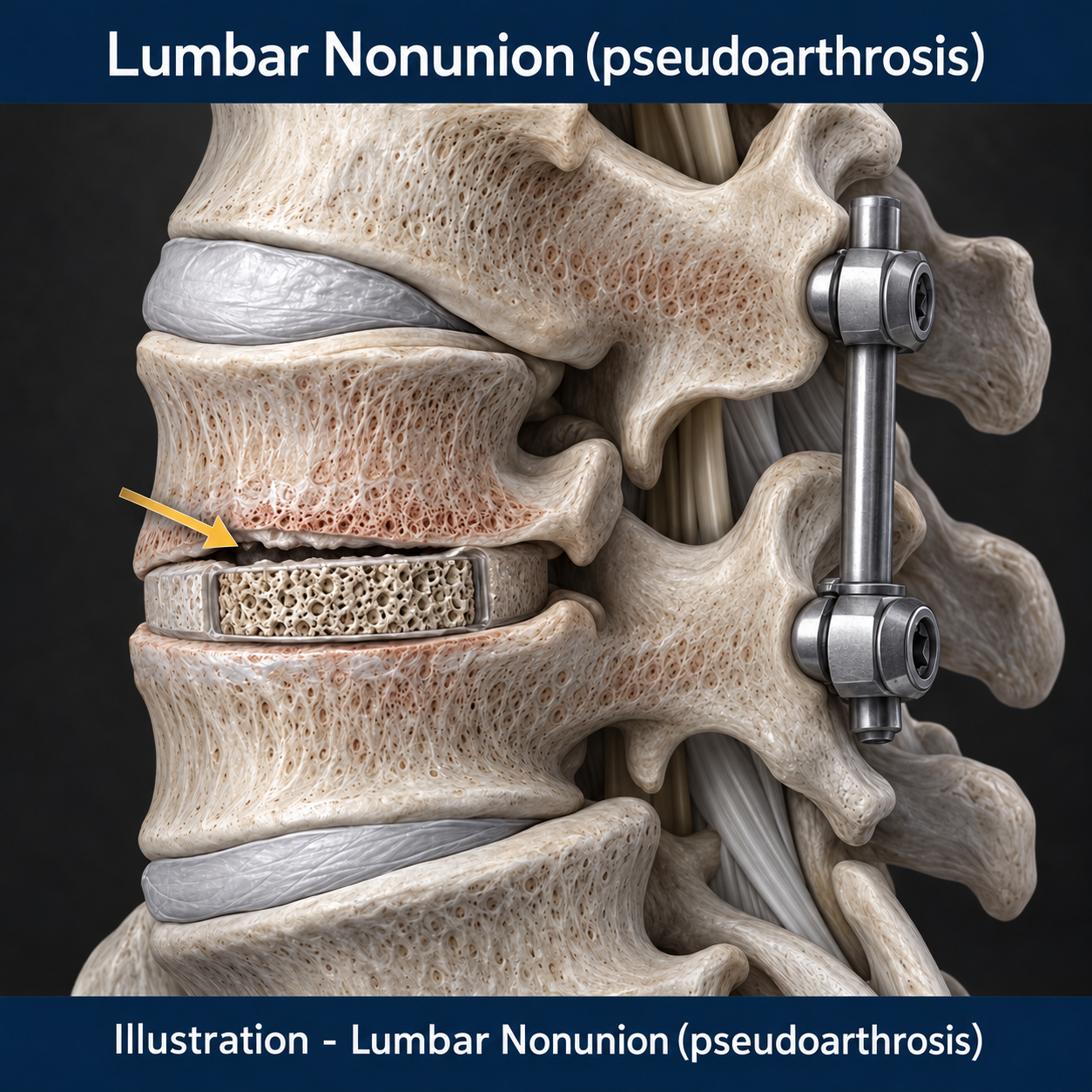
Educational illustrations, not patient scans. Pseudoarthrosis means an intended fusion has not formed a solid bony union. Imaging findings such as nonunion must be correlated with symptoms, physical examination, and the full clinical history before any treatment decision is made.
The Role of a Revision Spine Surgeon
A revision spine surgeon evaluates problems that persist or develop after a previous neck or lower-back operation. The goal is to understand whether there is a surgically correctable problem, whether nonsurgical care or further testing is more appropriate, and what risks and expected benefits apply to your individual situation.
For cervical concerns, this may involve reviewing prior ACDF, cervical fusion, disc replacement, or decompression in relation to neck pain, arm pain, numbness, weakness, or signs of recurrent compression. For lumbar concerns, this may involve reviewing prior discectomy, laminectomy, decompression, or fusion in relation to low-back pain, sciatica, leg symptoms, instability, walking limitation, or suspected fusion problems.
What a Revision Evaluation Includes
- ✓ Review of prior cervical or lumbar surgery, operative reports, and treatment history
- ✓ Review of the symptom timeline before surgery, after surgery, and with any recurrence or progression
- ✓ Review of current imaging, which may include MRI, CT, standing X-rays, or flexion-extension X-rays when indicated
- ✓ Focused examination of neck, arm, low-back, leg, strength, sensation, balance, and walking concerns
- ✓ Discussion of nonsurgical options, further diagnostic testing, and surgical options only when findings support them
Individualized Treatment Options
Revision treatment should be based on the specific diagnosis, not simply on the fact that prior surgery did not provide the expected relief. Depending on the findings, selected options may include nonsurgical care, additional testing, decompression for recurrent or residual nerve pressure, repeat lumbar discectomy for selected recurrent disc herniations, revision or extension fusion for symptomatic nonunion, instability, or adjacent-level disease, selected revision ACDF, or hardware revision when implants contribute to symptoms or mechanical problems.
Every option has individual risks, limitations, and expected benefits that should be discussed before a decision is made. No page can determine whether a patient needs surgery, and no recovery or outcome can be guaranteed.
- ✓ Nonsurgical care or further diagnostic workup when another operation is not the best next step
- ✓ Cervical or lumbar decompression when symptoms and imaging show recurrent or residual nerve pressure
- ✓ Repeat lumbar discectomy for selected recurrent disc herniations
- ✓ Revision or extension fusion for selected cases involving symptomatic nonunion, instability, alignment problems, or adjacent-level disease
- ✓ Selected revision ACDF or hardware revision when the diagnosis supports that approach
Why Patients Seek a Second Opinion at Apteum Spine
Revision decisions require time, clarity, and careful judgment. Apteum Spine is an independent private-practice spine surgery practice focused on direct physician evaluation, patient advocacy, and individualized decision-making. Your evaluation is not a rushed review of a scan. It is a detailed discussion of your symptoms, prior procedure, current imaging, and realistic options, including when another operation is not the right next step.
- ✓ Independent second-opinion perspective
- ✓ Direct physician evaluation of prior surgery and current findings
- ✓ Individualized treatment planning, including conservative care when appropriate
Request an evaluation or second opinion for persistent or recurrent symptoms after prior neck or lower-back surgery.
A Careful Second Opinion Before Another Spine Operation
For patients considering revision spine surgery, the most important question is not simply whether another surgery can be done. It is what is causing the symptoms, whether the finding is surgically correctable, and what the most responsible next step should be. Apteum Spine helps patients understand whether symptoms after prior cervical or lumbar surgery may be related to nerve compression, fusion status, adjacent-level disease, hardware concerns, instability, alignment, scar tissue, or another issue.
Symptoms Reviewed
Neck pain and arm pain
Numbness or weakness
Low-back pain and sciatica
Leg symptoms or walking limitation
New or recurrent symptoms after surgery
Possible Causes
Nonunion or pseudoarthrosis
Recurrent or residual compression
Adjacent-level disease
Hardware, instability, or alignment concerns
Other pain sources
Related Services
Revision spine surgery
Cervical spine surgery
Lumbar spine surgery
Spinal fusion
Second opinions
Frequently Asked Questions
Does pain mean prior surgery failed?
Not always. Pain or recurrent symptoms after surgery can have many causes, and some are not corrected by another operation. A second-opinion evaluation looks at your prior procedure, symptom pattern, examination, and current imaging to determine whether there is a treatable source and whether surgery, nonsurgical care, or more testing is appropriate.
What is pseudoarthrosis?
Pseudoarthrosis means that an intended spinal fusion has not formed a solid bony union. It may be described as a nonunion. Some nonunions can be symptomatic, while others may be found on imaging without clearly causing symptoms. The finding must be interpreted with your symptoms, examination, and imaging details.
What records should I bring?
If available, bring prior operative reports, imaging discs or reports, injection records, therapy history, medication history, and a timeline of symptoms before and after surgery. Current MRI, CT, standing X-rays, or flexion-extension X-rays may be helpful when indicated.
Is another fusion always needed?
No. Another fusion is not always needed after prior spine surgery. Depending on the diagnosis, options may include nonsurgical care, further diagnostic testing, decompression, repeat lumbar discectomy, selected revision ACDF, hardware revision, or revision or extension fusion. The right plan depends on how the findings relate to your symptoms and examination.
When is urgent care needed?
Seek urgent or emergency care for rapidly worsening weakness, new bowel or bladder dysfunction, saddle numbness, sudden neurologic change, or fever with severe postoperative pain. Call 911 or go to the nearest emergency room for emergencies.
This page is for general education and is not a substitute for medical advice, diagnosis, or treatment. For urgent symptoms, call 911 or go to the nearest emergency room.
Request a Second Opinion for Symptoms After Neck or Lower-Back Surgery
If you are dealing with persistent or recurrent neck, arm, low-back, sciatica, leg, or walking symptoms after prior spine surgery, Apteum Spine can help you understand your options.

Experience & careful judgment
Meet Dr. Cornacchia.
Louis G. Cornacchia III, M.D., FAANS, FACS
A board-certified neurosurgeon with 30 years of spinal cord stimulation experience.
More about Dr. Cornacchia’s experience and SCS device decisions
Spinal cord stimulation experience
Experienced neurosurgical judgment before device decisions.
A spinal cord stimulator is a medical device decision, but it is also a diagnosis decision. Apteum’s evaluation is designed to clarify whether SCS is reasonable, whether another spine problem needs attention, and what goals should define success for you.
He works with a community of experienced pain-management doctors and with Medtronic, Boston Scientific, and other manufacturers.
Manufacturer relationships do not imply endorsement of a specific device for every patient. Brand and system selection should be based on clinical need, anatomy, MRI considerations, programming goals, prior device history, and shared decision-making.

 Additional systems as clinically appropriate
Explore Dr. Cornacchia’s training and experience ↗
Your evaluation focuses on your diagnosis, prior care and goals. Discuss the expected benefits, limitations, risks and alternatives before choosing your next step. An evaluation is not a commitment to surgery or an implant.
Read Dr. Cornacchia’s training and experience →How spinal cord stimulation works
Watch this explanation created by Dr. Cornacchia. Spinal cord stimulation is one option for selected patients after evaluation; it is not appropriate for every cause of pain and does not replace the discussion of the treatment on this page.
Take your next step with clarity.
Request an evaluation of your condition and options. Our team will contact you to discuss your request and arrange the next step.
Your request does not confirm an appointment.