

Back or leg symptoms?
Understand your next step.
Review your symptoms, imaging and treatment history before deciding whether TLIF or another treatment fits your diagnosis.
Request a TLIF Evaluation (Form)Telehealth or in person. Your request does not confirm an appointment.
A careful review before a surgical decision.
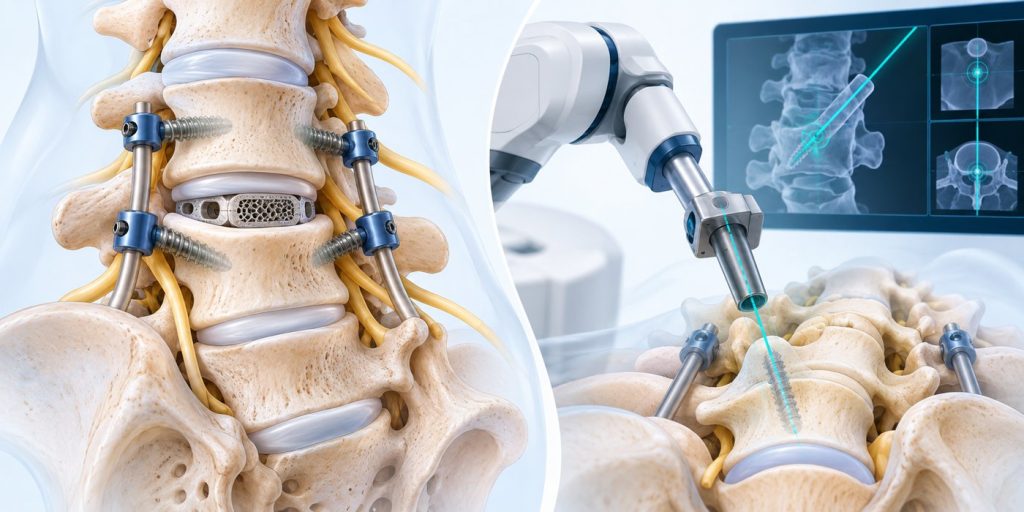
TLIF approaches the lumbar disc space from one side of the back to decompress nerves, place an interbody cage and stabilize the segment with screws and rods. First, we assess whether fusion fits your diagnosis.
Bring your imaging
Bring available lumbar imaging and prior operative reports.
Discuss the alternatives
Review previous care, nonsurgical options, expected benefits, limitations and risks.
Choose the appropriate next step
Surgery is discussed when symptoms, examination and imaging support it. No outcome is guaranteed.

Experience & careful judgment
Meet Dr. Cornacchia.
Louis G. Cornacchia III, M.D., FAANS, FACS
A board-certified neurosurgeon with 30 years of experience and thousands of spine surgeries performed. Every patient is evaluated as a unique presentation worthy of careful study.
Experience applied to TLIF
For TLIF consultations, Dr. Cornacchia brings that experience to a careful review of your lower-back and leg symptoms, examination, lumbar imaging, and any previous treatment. The decision about fusion, the surgical approach, and whether robotic guidance has a role is made for your individual presentation.
More about Dr. Cornacchia’s experience and SCS device decisions
Spinal cord stimulation experience
Experienced neurosurgical judgment before device decisions.
A spinal cord stimulator is a medical device decision, but it is also a diagnosis decision. Apteum’s evaluation is designed to clarify whether SCS is reasonable, whether another spine problem needs attention, and what goals should define success for you.
He works with a community of experienced pain-management doctors and with Medtronic, Boston Scientific, and other manufacturers.
Manufacturer relationships do not imply endorsement of a specific device for every patient. Brand and system selection should be based on clinical need, anatomy, MRI considerations, programming goals, prior device history, and shared decision-making.

 Additional systems as clinically appropriate
A neurosurgeon who evaluates lumbar spine conditions and reviews your symptoms, imaging, prior care and goals. The conversation starts with diagnosis, before choosing hardware or a robot.
Your evaluation focuses on your diagnosis, prior care and goals. Discuss the expected benefits, limitations, risks and alternatives before choosing your next step. An evaluation is not a commitment to surgery or an implant.
Read Dr. Cornacchia’s training and experience →How spinal cord stimulation works
Watch this explanation created by Dr. Cornacchia. Spinal cord stimulation is one option for selected patients after evaluation; it is not appropriate for every cause of pain and does not replace the discussion of the treatment on this page.
Full TLIF evaluation, treatment, recovery, risks and FAQs
TLIF and Robotic TLIF Surgery
A planned lumbar fusion pathway for selected patients with nerve compression, instability, disc collapse or recurrent leg and back symptoms.
Transforaminal lumbar interbody fusion, often called TLIF, is a spine surgery that approaches the disc space from one side of the back to decompress nerves, place an interbody cage and stabilize the segment with screws and rods.
At Apteum Spine, evaluation starts with your imaging, neurologic exam, prior treatment history and goals. Minimally invasive TLIF or robotic TLIF may be considered when it fits your anatomy and diagnosis.
Our team will contact you to discuss your request and arrange the next step. Your request does not confirm an appointment.
COORDINATED LUMBAR FUSION PLANNING
One evaluation focused on the real question: is fusion the right next step for you?
TLIF is not a first step for every back-pain problem. Apteum’s process is designed to determine whether symptoms, imaging and prior treatment support a fusion procedure—or whether decompression alone, injections, therapy, medication changes, observation or another approach may be more appropriate.
Diagnosis before technique
The conversation starts with what is causing the pain or nerve symptoms, not with choosing hardware or a robot.
Individual surgical planning
If TLIF is reasonable, the plan considers level, side of approach, decompression needs, cage strategy, fixation, bone quality and prior surgery.
Robotics when appropriate
Robotic navigation may assist pedicle screw planning and guidance. It is a tool used selectively, not a guarantee and not the only way to perform accurate spine surgery.
Who may need a TLIF evaluation?
A TLIF evaluation is often considered when lumbar nerve compression and mechanical instability or disc collapse overlap. The goal is to understand whether decompressing the nerves and stabilizing the segment may be appropriate for your specific condition.
Problems that may prompt TLIF discussion
- Leg pain from nerve compression. Sciatica, radiculopathy, numbness or weakness linked to foraminal stenosis, recurrent disc problems or collapsed disc space.
- Spondylolisthesis or instability. Slippage or abnormal motion that may require stabilization in addition to nerve decompression.
- Degenerative disc collapse with stenosis. Loss of disc height that narrows the nerve exit passage and contributes to back and leg symptoms.
- Selected revision situations. Prior lumbar surgery with recurrent compression, scar, instability or structural problems that need careful imaging review.
What TLIF does — and does not do
TLIF is designed to decompress selected nerves and stabilize a lumbar spinal segment using an interbody cage, bone graft material and screw-rod fixation.
It does not treat every cause of back pain, does not reverse all nerve damage, and does not guarantee pain relief or fusion success. Your evaluation should separate nerve compression, instability, hip or vascular problems, neuropathy and other pain generators.
A stepwise pathway from imaging review to surgical decision.
TLIF planning combines diagnosis, patient goals, anatomy, risk assessment and alternatives. If surgery is appropriate, the operation may be open, minimally invasive or robot-assisted depending on the case.
Transforaminal lumbar interbody fusion
TLIF approaches the disc space through a posterior, one-sided corridor. The surgeon can remove pressure from nerves, prepare the disc space and place an interbody cage to support the segment.
Minimally invasive TLIF
In selected patients, a smaller muscle-sparing approach may be used. Suitability depends on anatomy, level, prior surgery, body habitus, deformity, instability and the amount of decompression needed.
Robotic TLIF
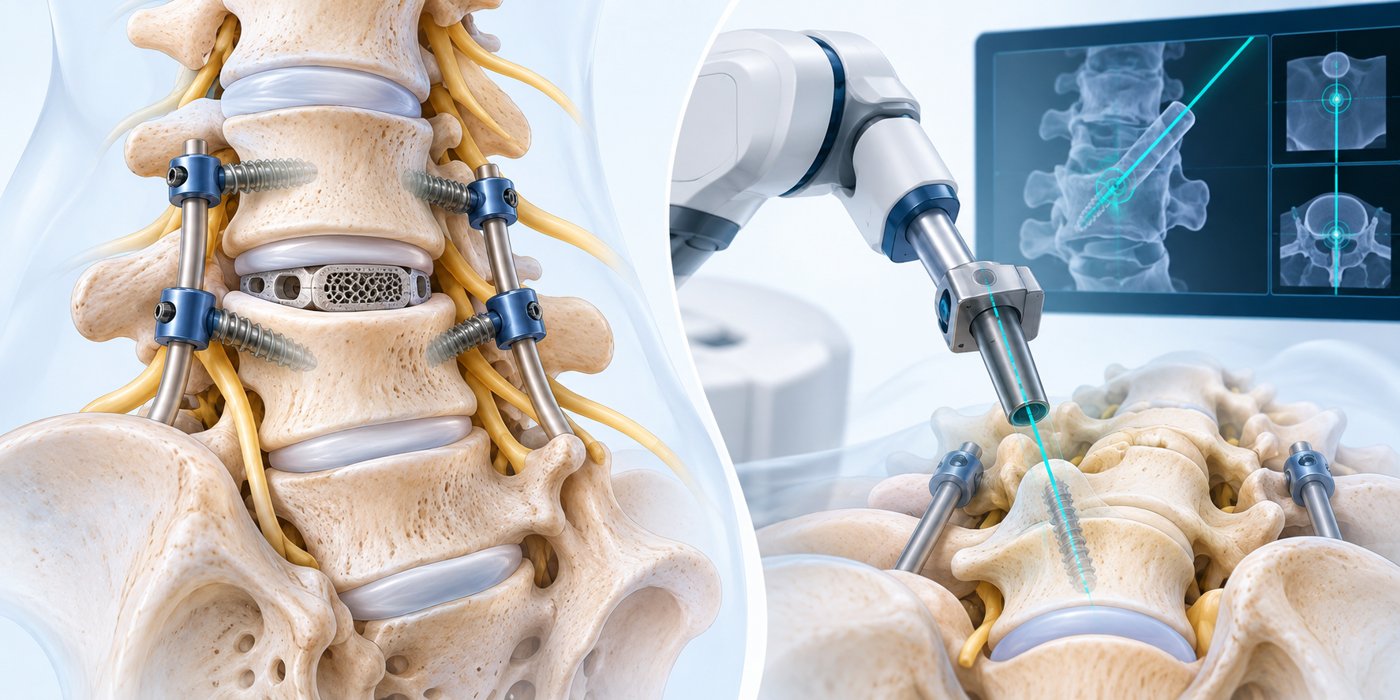
Robotic navigation may assist with preoperative planning and intraoperative guidance for pedicle screw trajectories. The surgeon remains responsible for the plan and the procedure.
Your TLIF evaluation and treatment pathway
A decision at each stage. A plan that should fit your diagnosis, not just the name of a procedure.
- 1
Identify the pain generator
Review symptoms, physical exam, MRI/CT/X-rays and prior treatment to determine whether nerve compression, instability, disc collapse or another condition is driving symptoms.
- 2
Compare alternatives
Discuss whether nonsurgical care, injection-based care, decompression alone, disc replacement, a different fusion approach or continued monitoring may be better suited to your case.
- 3
Plan the decompression and fusion
If TLIF is appropriate, plan the surgical level, side of approach, nerve decompression, disc-space preparation, interbody cage position, graft strategy and screw-rod fixation.
- 4
Use navigation or robotics when it fits
For robotic TLIF, 3D imaging and navigation can support surgeon-planned screw trajectories and rigid robotic guidance. The surgeon verifies anatomy and makes clinical decisions throughout.
- 5
Perform decompression, cage placement and fixation
The operation typically includes removing pressure from nerves, preparing the disc space, placing an interbody cage with graft material and stabilizing the level with screws and rods.
- 6
Recover and monitor healing
Recovery planning may include wound care, activity restrictions, walking progression, physical therapy timing, medication review, imaging follow-up and monitoring for fusion and neurologic improvement.
If TLIF is not the right fit
The evaluation can still be valuable. Apteum may recommend continued nonsurgical care, pain-management options, a different surgical strategy, updated imaging or a second-opinion review before any operation is planned.
Bring records when possible: MRI/CT/X-ray images and reports, operative reports, injection notes, therapy records, medication list, medical conditions, nicotine history and any prior fusion or hardware details.
Ready to discuss whether TLIF fits your diagnosis?
Request an evaluation so Apteum can review your symptoms, imaging, prior treatment and goals.
Robotic precision: a planned path for every screw
Robotic TLIF translates a surgeon-created plan into the operating room with 3D imaging, rigid robotic guidance and real-time navigation. Each planned screw trajectory is selected for the patient’s anatomy and checked during surgery.
How the planning works
- 3D imaging supports planning. CT-based or intraoperative imaging can help map bony anatomy and spinal alignment.
- The surgeon plans trajectories. Screw paths are selected based on anatomy, level, bone corridors, hardware goals and the overall fusion plan.
- Rigid robotic guidance assists alignment. The robotic arm helps guide instruments along the planned path while the surgeon controls the operation.
- Navigation provides spatial feedback. Real-time navigation helps the team relate instruments to the patient’s anatomy during the procedure.
Published accuracy with ExcelsiusGPS
98.0%
A 2024 systematic review reported a weighted 98.0% rate of Gertzbein–Robbins grade A or B pedicle screws for ExcelsiusGPS (95% CI 97.2%–98.6%). Grade A or B describes no breach or a breach under 2 mm; it does not mean every screw precisely matched the planned path.
The review included 46 studies across four robotic systems. These are published screw-placement results, not Apteum outcomes or a personal probability of pain relief.
Read the 2024 robotic accuracy review
What the accuracy evidence means for your care
Robotic guidance brings the surgeon’s planned trajectory, rigid instrument alignment and navigation feedback together during screw placement. Published comparative studies support high accuracy and improved placement versus fluoroscopy-guided techniques.
Accurate placement remains possible with other accepted techniques. Robotics assists the operation; diagnosis, surgical judgment, anatomy and bone healing still determine the overall result.
View robotic TLIF evidence details and citations
PEDICLE SCREW ACCURACY EVIDENCE
Robotic assistance vs fluoroscopy-guided techniques
A 2024 meta-analysis of 12 randomized controlled trials reported higher pedicle screw placement accuracy with robot-assisted techniques compared with conventional fluoroscopy-guided techniques.
The same analysis reported similar complications, radiation exposure time and operative duration between groups. This describes study populations and techniques, not Apteum-specific results.
Globus ExcelsiusGPS technology
ExcelsiusGPS is described by Globus Medical as a platform that combines navigation and robotic guidance for spine procedures. System capabilities should be discussed in the context of your anatomy, imaging and surgical plan.
View Globus ExcelsiusGPS information
Manufacturer information explains system capabilities; it does not prove that every patient will have a better outcome.
Accuracy is not the same as outcome guarantee
Pedicle screw placement accuracy is an important technical endpoint. Pain relief, neurologic recovery, fusion healing and return to activity depend on diagnosis, decompression, biology, bone quality, smoking/nicotine status, medical conditions, rehabilitation and other factors.
Do not interpret the odds ratio above as a personal probability of benefit. It is a study-level comparison of screw placement accuracy, not a guarantee of pain relief, fusion success or complication avoidance.
Request a telehealth or in-person TLIF evaluation.
If lumbar pain, leg pain, numbness, weakness or walking limits are affecting your life—and imaging suggests stenosis, disc collapse, spondylolisthesis, instability or recurrent compression—Apteum can help you understand whether TLIF or robotic TLIF deserves consideration.
Prepare for your visit
For the most useful evaluation, bring or upload lumbar MRI/CT/X-ray reports and discs, prior operative reports, injection notes, physical therapy history, medication list and a summary of symptoms, walking tolerance and neurologic changes.
Our team will contact you to discuss your request and arrange the next step. Your request does not confirm an appointment.
Contact
TLIF and Robotic TLIF FAQ
What does TLIF stand for?
Who may be a candidate for TLIF?
Is minimally invasive TLIF always better?
What is robotic TLIF?
Does robotic guidance guarantee better results?
What are the risks of TLIF?
How long is recovery after TLIF?
What records should I bring?
Evidence reference: 2024 robotic pedicle screw accuracy meta-analysis | System capability reference: Globus ExcelsiusGPS
Find out whether TLIF fits your diagnosis.
Request an evaluation to review your symptoms, imaging, goals and prior treatment history.
The team will contact you to discuss your request. No outcome is guaranteed.