

A tie rod breaks in your car. Your mechanic replaces it, checks the alignment, and the car may drive much as it did before. You expect the replacement to last, and you may never have to think about that particular part again.
It is understandable to bring that same expectation to spine surgery. Find the damaged part. Replace it. Get back to normal.
But your body is living tissue. That changes what repair means.
Your spine is built and maintained by cells
Your body is about 60% water by weight. The exact proportion varies with age and body composition. That water is part of your cells and the fluids surrounding them, helping transport nutrients and support normal biological processes. Even tissues that feel solid contain water. Your spine belongs to this living, water-rich system. Learn more from the U.S. Geological Survey.
Your spine has a structure that can look mechanical: bones support weight, joints allow motion, and ligaments help hold everything together. Muscles move and stabilize it. Nerves carry the signals that make movement and sensation possible. These structures belong to a living system.
Your body is constantly renewing itself. Many cells die and are replaced by new cells, but each tissue has its own timetable. Some cells turn over quickly, but it is inaccurate to say that almost every cell in your body is replaced within six months. Important exceptions include many neurons—the nerve cells in your brain and spinal cord—which can last a lifetime. Other cell types also have longer lifespans, so renewal follows different schedules throughout the body. Read the NIH guide to the life and death of neurons. This ongoing renewal helps maintain living tissues, but it does not mean that every tissue can regenerate completely or that an aging spinal disc becomes new again. Learn more about cell turnover from the National Institute of General Medical Sciences.
Cells produce and maintain the materials around them. In a spinal disc, that material helps the tissue retain water and carry loads. With aging and degeneration, the balance between maintaining tissue and breaking it down can change. Research on disc-cell aging has identified changes that favor tissue breakdown. This is part of the biology behind degeneration, rather than a complete explanation for every patient’s condition. Read the research on disc cells and tissue maintenance.
Mechanical stresses still matter. Biology and mechanics interact: the condition of a tissue affects how it carries a load, and loading can affect the tissue. Describing all degeneration as simple “wear and tear” misses that relationship. Describing it only as cells failing to rebuild would also leave part of the story out.
A scan is one part of the diagnosis
An aging disc or arthritic joint on an MRI is not automatically the cause of pain. Degenerative changes can exist in people who remain active and have little or no pain. The important question is how the imaging fits your symptoms and examination. AAOS explains aging changes and low back pain.
Before considering an operation, ask: What problem are we treating? Why do we believe this particular finding explains my symptoms? What improvement can this procedure reasonably offer?
What surgery can change
Spine surgery can address a specific structural problem. A decompression creates more room for compressed nerves. A discectomy removes disc material pressing on a nerve. A fusion aims to stabilize selected vertebrae by helping them heal together. Some patients are candidates for an artificial disc replacement. The right approach depends on the diagnosis and the individual. NIAMS describes these treatment options.
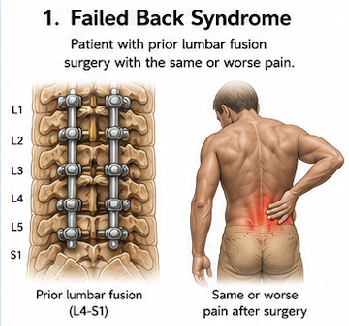
Even when a procedure replaces a disc or uses screws, rods, or a cage, the surrounding tissues remain alive. The operation does not reset the entire spine to a younger state or guarantee that every symptom will disappear.
The operation and the healing are different stages
During a fusion, implants can hold bones in position while bone graft and the body’s healing response work toward a solid union. The hardware provides support; it does not substitute for the biological process of forming bone.
That healing takes time, often several months. Activity restrictions, follow-up visits, and rehabilitation are part of treatment. Feeling better and being fully healed do not always happen at the same time. Your surgeon’s instructions should guide your progress. Read the AAOS guide to spinal fusion and recovery.
Recovery also needs a plan for the whole person. Discuss nutrition, tobacco use, other medical conditions, and the support you will need at home with your care team. These conversations help make the plan practical and appropriate for you.
Set goals around the life you want to regain
A useful surgical conversation goes beyond which implant will be used. Talk about walking, sleeping, working, caring for family, and the activities that pain has taken away. Ask which goals are realistic, which symptoms may persist, and what risks you would be accepting.
Surgery can provide meaningful improvement for appropriately selected patients. Understanding its limits is part of making an informed decision. Healing is a process you and your care team continue after the operation.
Your body is not a machine. Spine surgery is more than replacing parts.
For help understanding your options, explore Apteum Spine’s second-opinion information or request a consultation.
This article provides general education and does not replace individual medical advice.