

Failed Back Surgery Syndrome
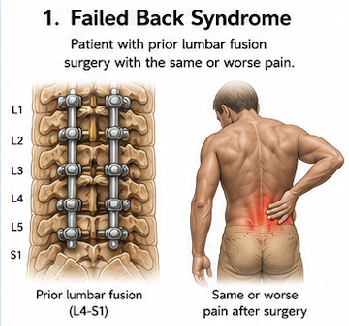
Failed back surgery syndrome – also known as failed back syndrome (FBS), refers to the pain that persists in the back and or the lower extremities after spinal surgeries.Our e-book is providing you with basic knowledge and other information you should know about failed back syndrome.
Your request does not confirm an appointment.
Still in pain after surgery?
Another operation is not automatically the next step. A careful second opinion reviews your symptoms, previous surgery, and imaging to clarify which options deserve consideration.
- Listen
Your history, symptoms, and goals.
- Review
Your imaging and previous treatment.
- Explain
Your options and the next steps.
Information for your evaluation
Let’s Take This To Your Inbox
What Are Possible Treatment Options For Failed Back Syndrome?
Before seeking medical treatment, it is good to understand and define the types of back pain so as to find the right treatment and ways to control and improve our condition.
Apteum Spine offers a wide variety of treatment options for patients with Failed Back Syndrome.
How Do I Seek Treatment For Failed Back Syndrome?
You’ll be offered a tailored treatment approach drawn from the full range of treatment options, including medication, physical therapy, and interventional pain management or surgery.
We make sure to find the root cause of your pain before any treatment path is given. Take the first step with a complimentary consultation.
What Is Failed Back Surgery Syndrome?
Failed back surgery syndrome (FBSS) describes continued or new pain following a spinal operation. If you are still in pain after spine surgery — or worse than before — you are not out of options. At Apteum Spine, Dr. Louis G. Cornacchia III focuses on these complex cases, starting with a clear answer to one question: why didn’t the first surgery deliver the relief you expected?
Why Surgery Sometimes Fails
• Incomplete decompression of the affected nerve
• Recurrent disc herniation
• Adjacent segment degeneration (problems next to a previous fusion)
• Hardware-related issues or a non-healing fusion
• An inaccurate original diagnosis
Treatment Options
We review your full surgical history and imaging, perform a careful neurological exam, and order new imaging as needed to identify the true source of your ongoing pain before making any recommendations.
Treatment Options
Depending on the cause, options range from targeted non-surgical care and injections to minimally invasive revision procedures or corrective surgery. Further surgery is recommended only when there is a clear, correctable problem and a realistic expectation of benefit.
Frequently Asked Questions
Can the problem still be fixed?
Often — when there is a specific, identifiable cause. A careful re-evaluation determines whether further treatment is likely to help.
Is it too late to get a second opinion?
It is rarely too late to be re-evaluated and understand your options.
Do You Have Any Questions?
We are here for you.
Medically reviewed by Louis G. Cornacchia III, M.D., FAANS, FACS — board-certified neurosurgeon. Last updated: June 2026. This page is for general education and is not a substitute for medical advice. For urgent symptoms, call (609) 831-0998 or go to the nearest emergency room.
ROBOTIC TLIF EXPERIENCE
When a lumbar revision may include robotic TLIF
Persistent pain after lumbar surgery calls for a careful review of the original operation, current imaging, and other treatment options. If an identified structural problem requires lumbar fusion, Dr. Cornacchia will discuss whether robotic TLIF is appropriate. Another fusion is not automatically the next step.
His experience includes over 500 robotic TLIF procedures and 8 years of robotic TLIF experience. He currently uses robotic assistance in every TLIF he performs. He plans and performs the surgery, with robotic guidance supporting planned instrument placement.
Explore robotic TLIF →
Experience & careful judgment
Meet Dr. Cornacchia.
Louis G. Cornacchia III, M.D., FAANS, FACS
A board-certified neurosurgeon with 30 years of spinal cord stimulation experience.
More about Dr. Cornacchia’s experience and SCS device decisions
Spinal cord stimulation experience
Experienced neurosurgical judgment before device decisions.
A spinal cord stimulator is a medical device decision, but it is also a diagnosis decision. Apteum’s evaluation is designed to clarify whether SCS is reasonable, whether another spine problem needs attention, and what goals should define success for you.
He works with a community of experienced pain-management doctors and with Medtronic, Boston Scientific, and other manufacturers.
Manufacturer relationships do not imply endorsement of a specific device for every patient. Brand and system selection should be based on clinical need, anatomy, MRI considerations, programming goals, prior device history, and shared decision-making.

 Additional systems as clinically appropriate
Explore Dr. Cornacchia’s training and experience ↗
Your evaluation focuses on your diagnosis, prior care and goals. Discuss the expected benefits, limitations, risks and alternatives before choosing your next step. An evaluation is not a commitment to surgery or an implant.
Read Dr. Cornacchia’s training and experience →How spinal cord stimulation works
Watch this explanation created by Dr. Cornacchia. Spinal cord stimulation is one option for selected patients after evaluation; it is not appropriate for every cause of pain and does not replace the discussion of the treatment on this page.
Take your next step with clarity.
Request an evaluation of your condition and options. Our team will contact you to discuss your request and arrange the next step.
Your request does not confirm an appointment.
Understand your next step.
Request an evaluation to review your symptoms, imaging, goals and prior treatment history.
The team will contact you to discuss your request. No outcome is guaranteed.