

Pain, tingling or weakness?
Understand your disc symptoms.
A herniated disc can press on nearby nerves. Review your symptoms and imaging to understand which treatment options fit your situation.
Request a Disc Evaluation (Form)Telehealth or in person. Your request does not confirm an appointment.
A careful review before a surgical decision.
A herniated disc occurs when the soft center of a spinal disc pushes through its outer layer. Your evaluation connects symptoms, examination and imaging before discussing nonsurgical care or surgery when appropriate.
Bring your imaging
Bring available spine imaging, reports and details of treatments you have tried.
Discuss the alternatives
Review previous care, nonsurgical options, expected benefits, limitations and risks.
Choose the appropriate next step
Surgery is discussed when symptoms, examination and imaging support it. No outcome is guaranteed.

Experience & careful judgment
Meet Dr. Cornacchia.
Louis G. Cornacchia III, M.D., FAANS, FACS
A board-certified neurosurgeon with 30 years of spinal cord stimulation experience.
More about Dr. Cornacchia’s experience and SCS device decisions
Spinal cord stimulation experience
Experienced neurosurgical judgment before device decisions.
A spinal cord stimulator is a medical device decision, but it is also a diagnosis decision. Apteum’s evaluation is designed to clarify whether SCS is reasonable, whether another spine problem needs attention, and what goals should define success for you.
He works with a community of experienced pain-management doctors and with Medtronic, Boston Scientific, and other manufacturers.
Manufacturer relationships do not imply endorsement of a specific device for every patient. Brand and system selection should be based on clinical need, anatomy, MRI considerations, programming goals, prior device history, and shared decision-making.

 Additional systems as clinically appropriate
Your evaluation focuses on listening, reviewing your imaging and explaining your options clearly. Surgery is considered when it is appropriate for your case.
Your evaluation focuses on your diagnosis, prior care and goals. Discuss the expected benefits, limitations, risks and alternatives before choosing your next step. An evaluation is not a commitment to surgery or an implant.
Read Dr. Cornacchia’s training and experience →How spinal cord stimulation works
Watch this explanation created by Dr. Cornacchia. Spinal cord stimulation is one option for selected patients after evaluation; it is not appropriate for every cause of pain and does not replace the discussion of the treatment on this page.
Full herniated disc information, treatment and FAQs
Herniated Disc
A herniated disc — also called a slipped or ruptured disc — is one of the most common causes of back and neck pain. At Apteum Spine, we offer personalized treatment plans ranging from conservative care to minimally invasive robotic surgery.
Your request does not confirm an appointment.
Your scan is only part of the story.
Your evaluation connects your symptoms, examination, and imaging before discussing care options.
- Listen
Your history, symptoms, and goals.
- Review
Your imaging and previous treatment.
- Explain
Your options and the next steps.
Information for your evaluation
What Is a Herniated Disc?
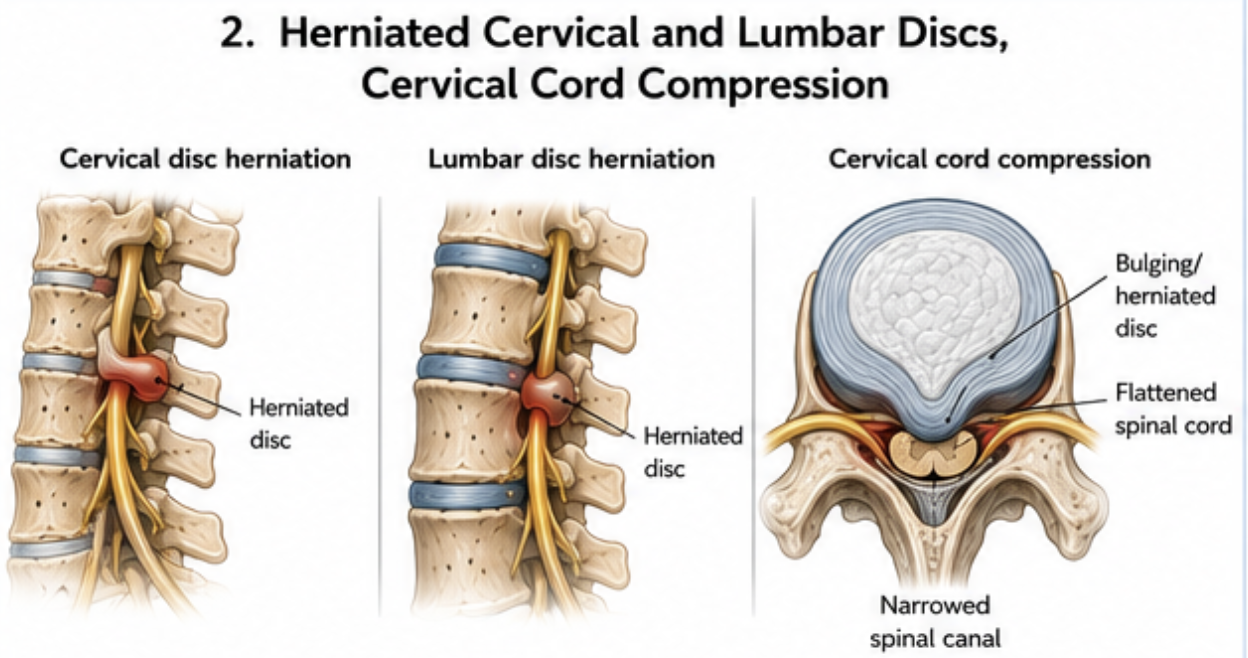
A herniated disc occurs when the nucleus pulposus — the soft, gel-like center of an intervertebral disc — pushes through a tear in the annulus fibrosus, the tough outer layer. This can happen in any part of the spine but is most common in the lumbar (lower back) and cervical (neck) regions. The displaced disc material can press on spinal nerves, causing pain, numbness, or weakness in the arms or legs.
What Causes a Herniated Disc?
Disc herniation is often the result of gradual, age-related wear and tear called disc degeneration. As you age, your discs become less flexible and more prone to tearing or rupturing with even a minor strain or twist. Risk factors include heavy lifting with improper form, being overweight, repetitive motions that stress the spine, and a sedentary lifestyle. Genetics can also play a role in disc degeneration.
How Is a Herniated Disc Diagnosed?
Diagnosis typically begins with a physical examination and review of your medical history. Your doctor may test your reflexes, muscle strength, walking ability, and sensitivity to touch. Imaging tests such as MRI, CT scan, or X-rays may be ordered to confirm the diagnosis and determine the exact location and severity of the herniation.
Common Symptoms
- Sharp or burning pain in the back, neck, arms, or legs
- Numbness or tingling in the affected area
- Muscle weakness in the arms or legs
- Pain that worsens with certain movements
- Pain that radiates down one side of the body
Treatment Options
- Physical therapy and rehabilitation
- Anti-inflammatory medications and pain management
- Epidural steroid injections
- Minimally invasive discectomy
- Robotic-assisted spinal surgery
What Is a Herniated Disc?
A herniated disc happens when the soft center of a spinal disc pushes through its tougher outer wall, often pressing on nearby nerves. It is one of the most common causes of back, neck, and radiating limb pain — and one of the most over-treated. At Apteum Spine, we confirm the diagnosis carefully and pursue the least invasive effective treatment first.
Symptoms
• Pain in the back or neck, often radiating into an arm or leg
• Numbness, tingling, or “pins and needles” along a nerve path
• Muscle weakness in the affected limb
• Pain that worsens with certain movements, coughing, or sitting
Treatment Options
• Activity modification, physical therapy, and anti-inflammatory medication
• Epidural steroid injections for nerve inflammation
• Minimally invasive microdiscectomy when conservative care fails or there is progressive weakness
• Disc replacement or fusion only in select cases
When to Seek Care
See a specialist for pain that persists beyond a few weeks, radiates down a limb, or comes with weakness. Seek emergency care for sudden severe weakness or loss of bladder or bowel control.
Causes & Risk Factors
Discs weaken naturally with age, making herniation more likely. Lifting with poor mechanics, repetitive strain, sudden injury, excess weight, and smoking all raise the risk.
Diagnosis
Diagnosis combines your symptom history, a physical and neurological exam, and imaging — typically MRI — to confirm which disc and nerve are involved before any treatment decision.
Frequently Asked Questions
Can a herniated disc heal on its own?
Many improve over weeks to months as inflammation subsides and the body reabsorbs part of the disc material.
Is surgery always needed?
No — most herniated discs are managed without surgery. Surgery is reserved for cases with persistent symptoms or nerve compression that hasn’t responded to conservative care.
Medically reviewed by Louis G. Cornacchia III, M.D., FAANS, FACS — board-certified neurosurgeon. Last updated: June 2026. This page is for general education and is not a substitute for medical advice. For urgent symptoms, call (609) 831-0998 or go to the nearest emergency room.
Take your next step with clarity.
Request an evaluation of your condition and options. Our team will contact you to discuss your request and arrange the next step.
Your request does not confirm an appointment.
Understand your herniated disc treatment options.
Request an evaluation to review your symptoms, imaging, goals and prior treatment history.
The team will contact you to discuss your request. No outcome is guaranteed.